When wafer capacity and supplier attention shift toward the fastest-growing, highest-margin programs, downstream sectors often absorb the disruption later, with less visibility, fewer approved alternatives, and less room to redesign. By the time healthcare, industrial, or consumer programs see the risk clearly, lead times may already be stretching, availability may already be tightening, and the cost of reacting may already be climbing.
Some industry leaders now warn that wafer tightness linked to AI demand could persist until 2030. For downstream teams, that is a reminder that concentrated demand in one part of the market can create sourcing pressure far beyond it.
Key Takeaways:
- Headlines miss the full story: The semiconductor shortage is not limited to AI and automotive, because supply pressure often spreads into downstream markets later and with less warning.
- Shortages spread in stages: Concentrated demand, fab capacity prioritization, supply chain bottlenecks, and lean inventory practices can all amplify disruption beyond the sectors driving the headlines.
- Downstream sectors have less flexibility: Healthcare, industrial, and other long-lifecycle markets are often harder hit because redesign, substitution, and qualification can take time.
- Proactive planning protects continuity: Earlier visibility, broader sourcing strategies, and stronger quality controls give teams more room to manage electronic component shortages before conditions tighten further.
The Semiconductor Shortage Beyond the Headlines
The headline version of a semiconductor shortage usually follows the loudest end markets. The operational version is broader and more layered. What starts as concentrated demand in one part of the market can quickly reshape sourcing conditions far beyond it.
A clearer way to think about it is this:
- Demand concentrates first: AI, data infrastructure, and other high-growth markets absorb more supplier attention, capital, and production focus.
- Fab capacity prioritization follows: Suppliers allocate limited capacity based on profitability, volume, technology mix, and strategic customer demand.
- Supply chain bottlenecks build: Constraints in packaging, materials, logistics, and supporting components amplify pressure beyond the fab itself.
- Just-in-time inventory leaves little buffer: Lean inventory practices can work in stable markets, but they often amplify shortages downstream when availability tightens.
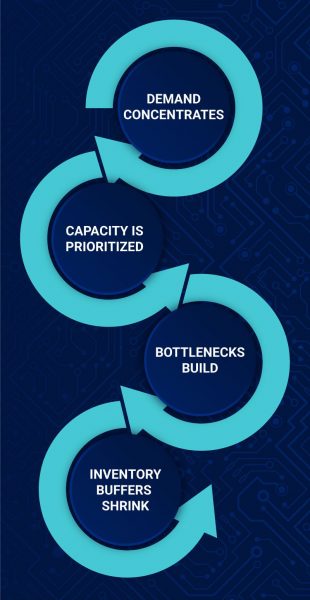
That ripple effect matters because downstream sectors rely on the same semiconductor ecosystem, even when they are outside the headlines. Recent U.S. government findings showed that mature-node and legacy chips remain essential across critical industries, including medical devices, and that many end users still have limited sourcing visibility. By the time that exposure becomes obvious, the market is often already less forgiving.
How a Downstream Semiconductor Shortage Develops
A downstream semiconductor shortage tends to hit hardest where redesign takes time, qualification is strict, or products depend on long-life parts. These sectors are not always first in line for supply pressure, but they are often among the least able to pivot once conditions tighten.
Healthcare cannot treat substitution as a simple sourcing fix
In healthcare, a component change rarely stays contained to procurement. Even a small substitution can create new demands around validation, documentation, traceability, and quality review. What looks like a sourcing issue on paper can quickly become a compliance and continuity issue in practice.
Strategic insight.: Identify high-risk components early and align sourcing, quality, and regulatory teams before substitution becomes urgent.
Industrial programs often carry legacy risk longer
Industrial manufacturers often support products and equipment for years, sometimes decades. That makes obsolete electronic components, mature-node devices, and hard-to-replace parts an ongoing exposure rather than a one-time event. In these environments, the challenge is not simply locating a substitute. It is protecting uptime, service obligations, and product reliability while keeping sourcing options open. That is why obsolescence management.
Strategic insight: Build obsolescence planning into lifecycle management so long-life products are not forced into reactive sourcing later.
Consumer electronics often feels allocation pressure through speed and price
Consumer electronics may have more redesign flexibility than healthcare or industrial markets, but that does not make it immune. When supply tightens, these programs often feel the pressure through unstable pricing, non-linear lead times, and sudden allocation shifts. Smaller brands and lower-volume buyers can be especially exposed when larger customers absorb more supplier attention.
Strategic insight: Monitor lead-time movement, pricing volatility, and supplier behavior closely so sourcing teams can act before allocation pressure fully materializes.
Early Signs of Semiconductor Supply Chain Disruption
Shortages rarely arrive as one dramatic signal. More often, they emerge through a series of smaller market changes that may seem manageable on their own, but become much more meaningful when they start to appear together.
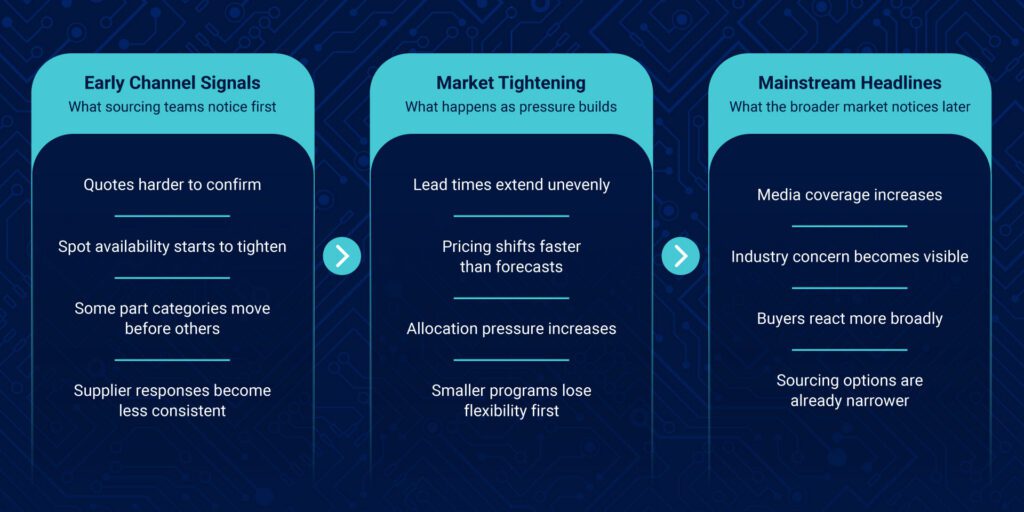
The value of these signals is not that any one of them confirms a shortage on its own. It is that, taken together, they reveal when the market is becoming less predictable and less forgiving. Teams that recognize that shift earlier usually have more sourcing flexibility than those waiting for broader confirmation.
That is why market visibility matters before a disruption becomes widely reported. The earliest signs of a semiconductor supply chain disruption often appear in quote activity, supplier responsiveness, and part-level availability long before they show up in mainstream coverage. By the time the headlines catch up, sourcing options are often already narrower.
How to Manage Semiconductor Shortage Risk Before It Hits
The companies that lose the least in a shortage are usually not the fastest reactors. They are the earliest planners.
A stronger response starts with a few practical questions:
1. Where is exposure concentrated?
Which products rely on aging, single-sourced, or lower-volume parts? Which programs are most vulnerable to electronic component shortages if a supplier reallocates capacity or lead times begin to stretch?
2. How flexible is the sourcing model?
A strong electronics sourcing strategy should not depend on one geography, one channel, or one assumption about availability. Broader global component sourcing can create more flexibility, especially when regional disruptions or allocation imbalances do not affect every source the same way.
3. Are quality controls strong enough for stressed-market buying?
When supply tightens, speed pressure rises, and so does counterfeit risk. That is when inspection discipline, supplier validation, traceability, and documented quality controls become even more important. In a stressed market, continuity depends on more than simply locating a part. It depends on locating supply that can be trusted.
Why Waiting for the Headlines Raises the Risk
The real lesson is not that every downstream sector will be hit the same way. It is that many will feel the effects only after supply conditions have already tightened. By then, the issue is no longer just availability or price. It is continuity, compliance, and how much sourcing flexibility remains.
That is why the companies that manage a semiconductor shortage best are usually the ones that act before the market forces them to. Earlier planning, broader sourcing options, and stronger quality discipline give teams more room to respond before conditions become more restrictive.

Partner with Velocity Electronics
When sourcing conditions begin to tighten, companies with stronger visibility, flexibility, and quality controls are usually better positioned to respond. That is especially true for teams managing hard-to-find parts or continuity risk.
Contact our team to explore practical next steps