Today, a component can remain technically available long after it has become commercially impractical to use. Inventory may appear in search results or supplier databases, but the available quantities may be too small, the lead times too long, the pricing too volatile or the sourcing conditions too uncertain to support production.
This is the obsolescence paradox: Access does not guarantee accessibility.
The question is no longer simply whether a component can be found. Procurement and supply chain teams must determine whether it can be obtained in the right quantity, within the required timeframe, at a viable cost and with the quality, traceability and continuity needed to protect production.
Understanding that distinction is the first step toward managing obsolescence as a continuity risk rather than a purchasing event.

“The issue is no longer simply whether or when a component becomes obsolete but if it remains commercially obtainable in quantities, lead times and pricing structures that make production viable.”
Kris Kelly, President and CEO, Velocity Electronics, in “Bridging the Obsolescence Gap,” Electronics Sourcing North America
Key Takeaways
- Access does not equal accessibility: A component may exist in the market without being available under the conditions production requires.
- Lifecycle status provides only part of the picture: Active parts can become difficult to procure, while obsolete parts may remain available through alternative channels.
- True accessibility depends on multiple conditions: Quality, quantity, timing, cost, technical usability and continuity must all be evaluated.
- Obsolescence risk often appears before end-of-life: Changes in inventory depth, lead times, pricing and allocation can provide earlier warning.
- Layered sourcing strategies create more options: Independent distribution can extend market reach and support continuity when primary channels narrow.
What Is the Obsolescence Paradox?
Lifecycle classifications remain useful for tracking component changes, but they do not always show whether a part can support the commercial and operational requirements of a specific program. That gap between formal lifecycle status and real-world usability defines the obsolescence paradox.
A procurement team may have access to a manufacturer, authorized distributor or established sourcing channel and still be unable to secure a component under the conditions production requires.
The distinction is critical:
- Access means a sourcing path exists.
- Availability means the component can be obtained in the required quantity, timeframe and condition at a commercially viable cost.
Lifecycle Status Can Hide Emerging Risk
Declining inventory, longer lead times, rising minimum order quantities and greater supply concentration can reduce accessibility while a component remains classified as active.
DDR4 illustrates this complexity. Some devices have reached end-of-life, while others remain in production for long-lifecycle applications. The technology may still appear broadly available even as specific part numbers, densities or packages become increasingly difficult to secure.
Obsolescence risk must therefore be evaluated at the component and application level, not through lifecycle status or technology category alone.
Six Conditions Determine True Component Accessibility
Identifying a source is only the beginning. Procurement teams must also determine whether the available supply can meet the operational, commercial and technical requirements of the program it supports.
Each condition matters independently, but true accessibility depends on all six working together. A part that meets quantity requirements but fails quality review, arrives after production is disrupted or provides no coverage for future demand may still leave the organization exposed.
The following checklist offers a practical framework for determining whether identified inventory represents production-ready supply.
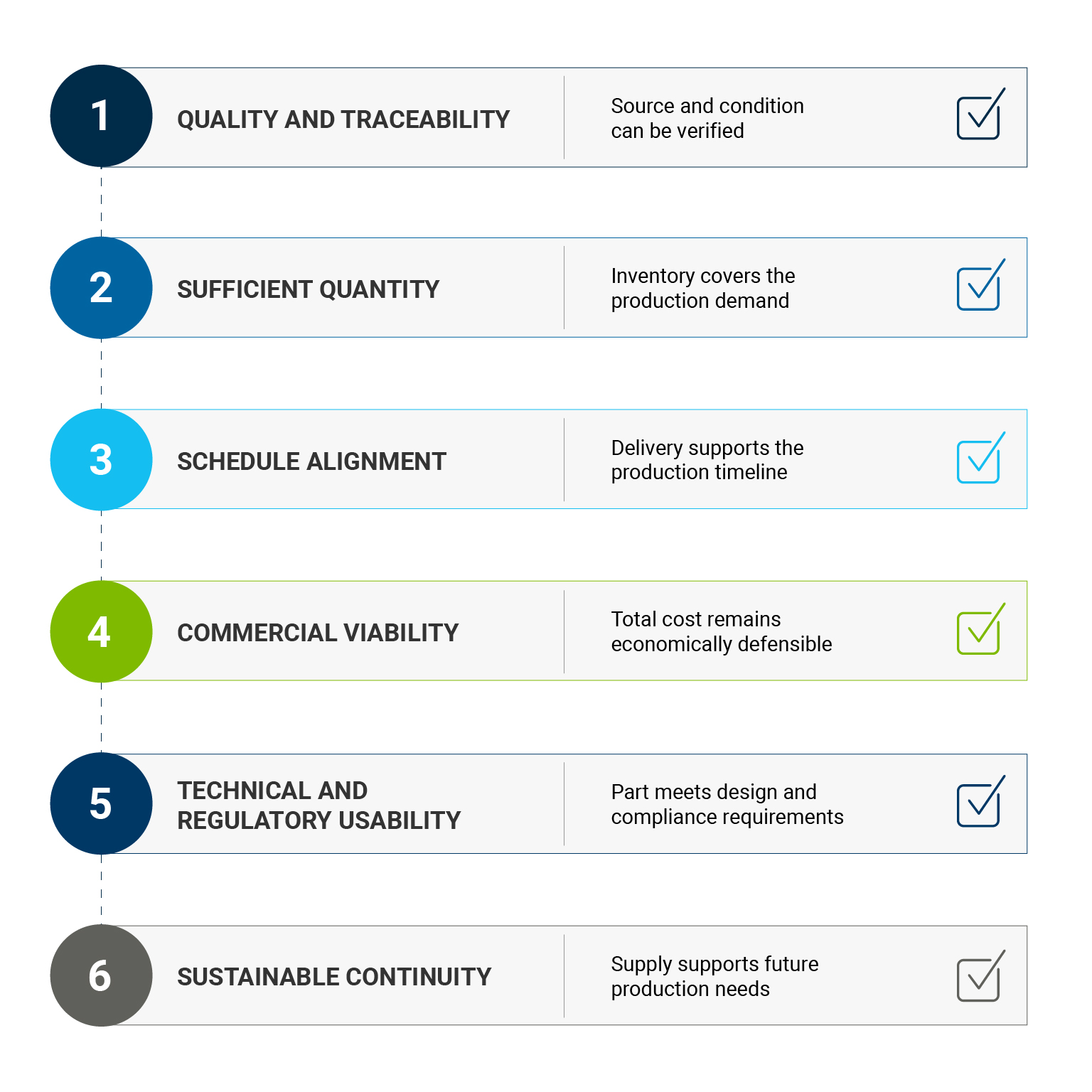
1. Verifiable Quality and Traceability
Can the source establish where the component originated, how it was handled and whether it meets the required quality standards?
As components move further from their original manufacturing date and primary distribution channels, traceability becomes increasingly important. Before inventory can enter production, procurement teams may need to complete supplier qualification, documentation review, visual inspection, electrical testing or other authentication measures.
A component that cannot satisfy the organization’s quality requirements may be physically available but operationally inaccessible.
2. Sufficient Quantity
Does the available inventory cover the actual requirement?
A search may reveal thousands of units distributed across several suppliers. However, that number can shrink quickly once date-code requirements, packaging, location, minimum orders and quality criteria are applied.
Fragmented inventory can support a repair requirement or short production run without providing enough coverage for the full manufacturing horizon. The existence of some supply should not be confused with the existence of sufficient supply.
3. Schedule Alignment
Can the component arrive before production is affected?
Long lead times, international transportation, customs requirements, testing schedules and supplier onboarding can all delay delivery. A component that arrives after a production line stops is not accessible in any meaningful operational sense.
This makes early identification essential. As supply diminishes, procurement teams typically have fewer sourcing, inventory and engineering options available, and less time to evaluate them.
4. Commercial Viability
Can the organization obtain the part without making the finished product uneconomical?
As supply tightens, pricing may increase substantially. Procurement teams must consider more than the unit price, including testing, freight, duties, storage, carrying costs and the administrative effort required to manage multiple sources.
Higher prices do not automatically make a component inaccessible. In some cases, paying a premium may still cost far less than a production interruption, emergency redesign or missed program commitment.
The decision must be evaluated against the operational and financial consequences of the alternatives.
5. Technical and Regulatory Usability
Can the available component be used without triggering additional engineering or compliance work?
Differences in revision, package, manufacturing location, date code, firmware behavior or material composition may affect whether inventory is acceptable for a particular design.
For long-lifecycle and regulated applications, even a seemingly equivalent alternate can require engineering review, testing, documentation updates, cybersecurity assessment, regulatory recertification or program approval. A technically similar part is not necessarily a drop-in solution.
6. Sustainable Continuity
Is the source a one-time opportunity or part of a supply strategy that can support future demand?
A single lot of inventory may solve an immediate shortage without addressing the underlying lifecycle risk. Once that supply is consumed, the organization could face the same problem under even tighter market conditions.
True accessibility therefore requires an understanding of inventory depth, forecasted consumption and the likely duration of the remaining supply, not simply confirmation that an order can be placed today.
Obsolescence Management Must Begin Before End-of-Life
- Changes in manufacturer investment and technology roadmaps
- Declining inventory depth across regions and channels
- Lead-time extensions or repeated delivery changes
- Increasing minimum order quantities
- Reduced availability of specific packages or configurations
- Supplier consolidation and geographic concentration
- Changes in pricing or allocation behavior
- Product change notifications and lifecycle classifications
- Demand growth from competing applications
“Continuity planning is becoming more valuable than reactive sourcing.”
Kris Kelly, President and CEO, Velocity Electronics
How Independent Distribution Helps Bridge the Accessibility Gap
- Broader global reach: Independent distributors can identify inventory across global markets, excess programs and alternative supply networks.
- Quality and traceability controls: Supplier qualification, documentation review, inspection and testing help determine whether located inventory is suitable for production.
- Flexible inventory strategies: Strategic stocking, bonded inventory and long-term storage can preserve supply without requiring immediate delivery or use.
- Lifecycle and market intelligence: Monitoring inventory depth, lead times and lifecycle signals can help procurement teams identify accessibility risks earlier.
- Transition support: Last-time-buy planning and alternative sourcing can provide additional time to qualify replacements, complete redesigns or manage an orderly transition.
Build Continuity Around Accessibility, Not Inventory Visibility
The obsolescence paradox exposes the limitations of treating component availability as a binary question. A part is not truly accessible simply because it appears in a database, carries an active lifecycle status or can be quoted by a supplier.
Production-ready supply must be available in the required quantity, on the right schedule and at a viable cost. It must also meet the technical, quality and traceability requirements of the application while providing enough continuity to support future demand.
Organizations that evaluate accessibility, not just access, can identify lifecycle risks earlier and act while sourcing, inventory and redesign options remain available. As Kris Kelly observes:
“Obsolescence may begin with a component, but its impact ultimately reveals the strength or weakness of the entire supply chain behind it.”
Overcome Obsolescence with Velocity
Velocity helps procurement, supply chain and engineering teams evaluate component availability against real production requirements.
Through global sourcing, market intelligence, quality assurance and flexible inventory strategies, we help our partners anticipate obsolescence risks and build continuity before access becomes a production constraint.
Explore how Velocity can help protect your long-term component supply here.
Contact Our Team
If your team is evaluating sourcing risk, quality requirements, or counterfeit exposure, contact our team to discuss how Velocity supports secure, flexible sourcing in higher-risk environments.
Contact our team to explore practical next steps